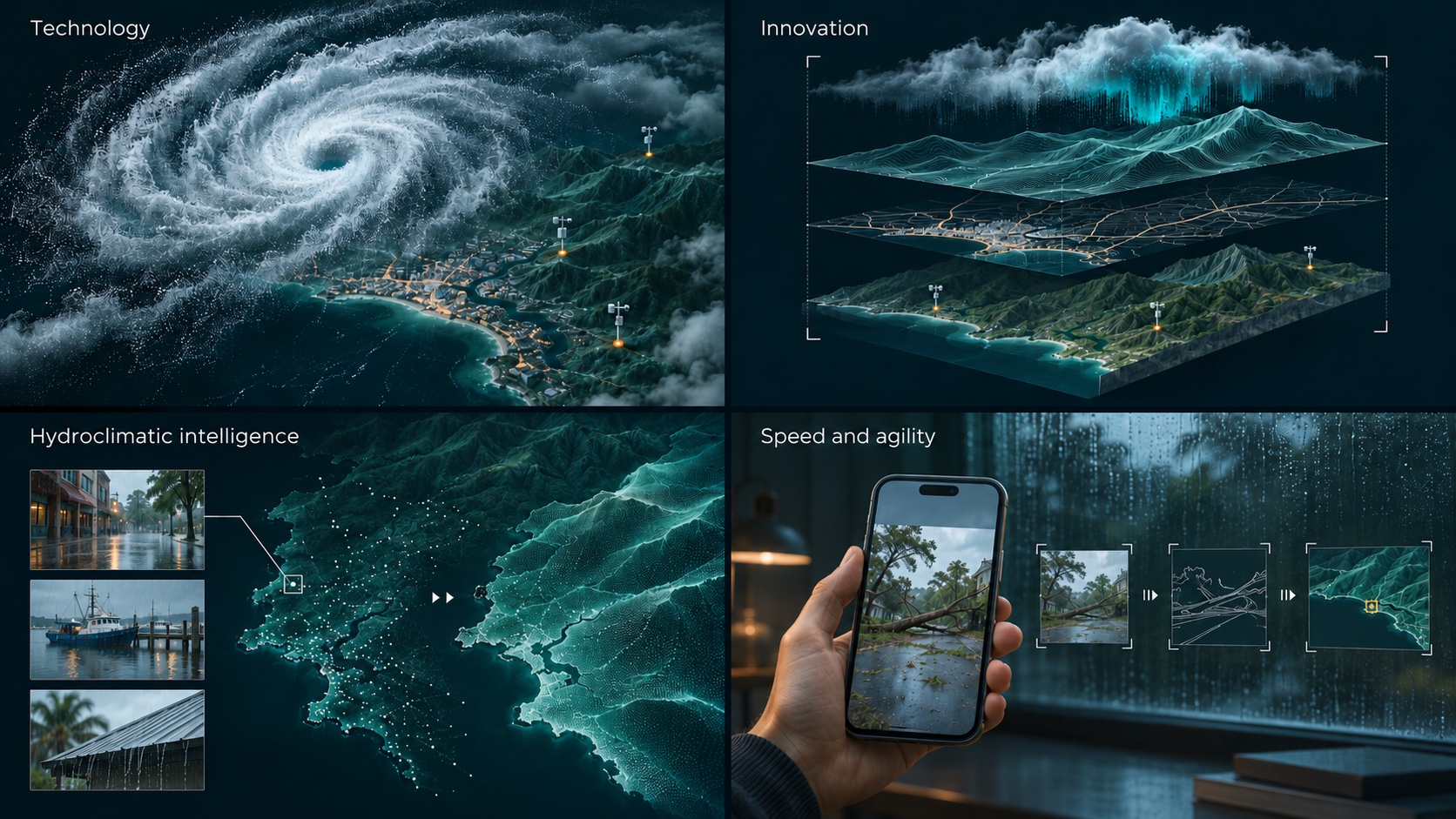
Technology
We put AI, machine learning and geospatial analysis to work on local impact. Our focus is evidence insurers, lenders and response organisations can inspect when assessing impact and supporting recovery.
About Landfall / Our mission
Landfall connects what people witness during floods, storms and hurricanes with the decisions that support recovery. Insurers can review product performance, lenders can prepare inspections and public agencies can follow conditions at essential facilities.
Explore our valuesAI-generated illustrations of Landfall’s technology and principles.
We put AI, machine learning and geospatial analysis to work on local impact. Our focus is evidence insurers, lenders and response organisations can inspect when assessing impact and supporting recovery.
We challenge established methods and test new approaches against real evidence problems. We judge each idea by the work it improves for contributors and customers.
We connect environmental data with local observations to explain what happened, where it happened and how conditions changed. Every interpretation stays connected to its source.
We prioritise the time between capture and usable evidence. We work in short cycles and test review time, coverage and source quality so speed serves a clear purpose.
Our goals
Our purpose is faster recovery. Our product goals focus on the evidence work that supports it. Each pilot sets the baseline, target and measures before it begins.
Reduce the time between a safe observation and a record ready for customer review.
Measure: capture-to-review timeKeep the original, source checks and review history attached throughout the evidence journey.
Measure: source completeness and review qualityGive insurers, mortgage servicers and catastrophe risk specialists a record they can carry through assessment, renewal and model evaluation.
Measure: preparation effort in the customer workflowThe founder’s story
Khrishawn Powell
Founder, Landfall Intelligence
Hurricane Melissa
October 2025
I watched Hurricane Melissa strengthen into a Category 5 storm on television. I was shocked and worried. Jamaica, where my mum and dad were born and where I had visited since childhood, was about to be hit.
Melissa made landfall on Tuesday, 28 October 2025. Then came the anxious wait to find out what had happened to the people and places I knew.
Images and videos began appearing online, shared through Starlink connections and media coverage. Seeing the devastation left me deeply upset. My family in Trelawny had been impacted. These were places I knew, and people I cared about.
My first instinct was to send money to family and friends so they could start putting their lives back together. I didn’t have much to send, or much money to put into an idea. But I knew I had my brain, my knowledge of data and AI, and the ability to build.
I believed what I knew could be worth more than the money I could send at that moment.
Between landfall on Tuesday and the end of that week, I quickly built prototypes. I wanted to use what I knew to help Jamaica recover.
As the weeks went on, I watched the work of rebuilding and the role banks and insurers played in getting homes repaired. From where I stood, it felt painfully slow. By November, my family and the country were still facing the long work of recovery.
That experience changed how I thought about the problem. Understanding the damage matters. Access to funds is also central to getting people back on their feet.
Homes need repairs. Businesses need to reopen. Roads, ports, marinas and utilities need to function again so a country can get moving. That work requires funding, and delays in accessing it can hold up everything that follows.
I began to see a role for the images and accounts people were already sharing. A phone image, its source, its time and its location could become evidence that response organisations, banks and insurers could work with. AI and machine learning could help organise those observations, connect them to places and events, and make them easier for people to review.
Those early prototypes became Landfall. We turn local observations into traceable evidence for insurers, lenders and response organisations assessing impact and supporting recovery. Our goal is to reduce the time spent gathering and repeating the same information while homes, businesses and essential infrastructure wait.
My background is in data science and AI. At Lloyds Banking Group, I built AI tools for banking teams. At Ofcom, I researched how AI models describe images and identify harmful content. At Scansan Properties, I built machine learning tools for UK property valuations. After Hurricane Melissa affected my family in Jamaica, I began putting that experience to work on Landfall.
Landfall has a clear purpose: useful evidence for the organisations working on recovery and a meaningful record for the people living through it. It began with my family in Jamaica. Our goal is to help industry, society and the public sector recover faster wherever the next storm strikes.
Khrishawn Powell
Melissa hit Jamaica as a Category 5 hurricane. The World Meteorological Organization identifies it as Jamaica’s strongest recorded landfall, tied for the Atlantic landfall record by maximum sustained wind speed.